Waist to Hip Ratio: Why Shape Matters as Much as Size
Location, location, location
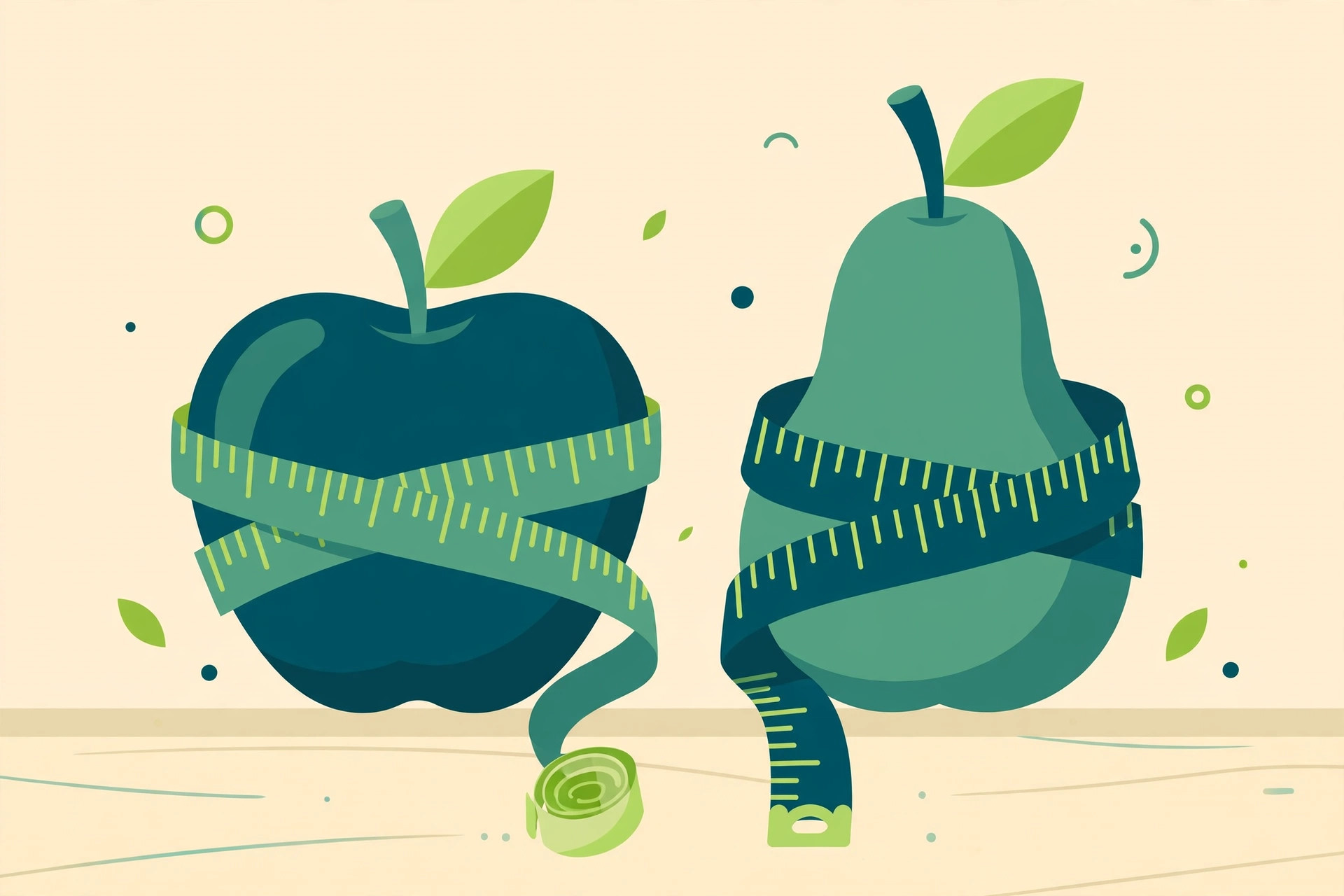
In the 1980s researchers noticed something odd: among people of the same weight, those shaped like apples, wide at the waist, developed diabetes and heart disease far more often than those shaped like pears, wide at the hips. The waist to hip ratio was built to capture that shape in one number: waist circumference divided by hip circumference. The biology underneath is visceral fat, the deep abdominal fat that wraps organs and drains directly to the liver, disturbing blood sugar and lipids. Hip fat, by contrast, sits under the skin and behaves comparatively quietly. Shape, it turns out, is a health signal in its own right.
The WHO bands
The World Health Organization translates the ratio into risk bands. For women, below 0.80 is low risk, 0.80 to 0.85 moderate, and above 0.85 high. For men, the cut points sit higher because male bodies naturally carry proportionally less hip: below 0.90 low, 0.90 to 1.0 moderate, above 1.0 high. These bands came from studies linking the ratio to cardiovascular events, and in several analyses the ratio predicted heart attacks better than BMI did, because it sees the distribution BMI misses. A rising ratio with a stable weight is still a warning: it can mean muscle lost from the hips while fat gathers at the waist.
Measuring without fooling yourself
Measure the waist at its narrowest point, or at the navel if no narrow point exists, standing relaxed, tape level, at the end of a normal breath out. Measure the hips at the widest point of the buttocks. Both over bare skin or one thin layer, tape snug without digging in. Take each twice and average. Then repeat monthly at most; shape changes slowly. If your ratio sits in the high band, it is useful information to bring to a check up, alongside blood pressure and blood tests, which together turn a shape into a proper risk picture. Our waist to hip calculator applies the WHO bands for your sex automatically; pair its verdict with a blood pressure reading and you have the two cheapest powerful risk checks in everyday medicine.